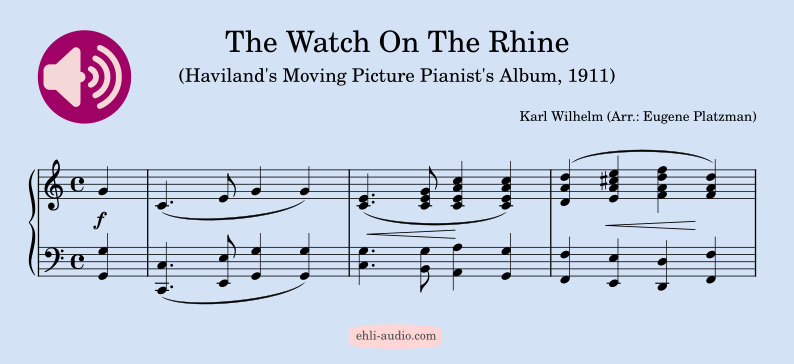
Following a political crisis between France and Germany, nationalism flared up within the states of the German Confederation (Deutscher Bund) from 1840 onwards. A sense of national consciousness also stirred among artists, leading, among other things, to the creation of the patriotic poem "Die Wacht am Rhein" ("The Watch on the Rhine"), which was set to music by the German composer Carl Wilhelm (1815–1873) in 1854.
During the Franco-Prussian War of 1870–71, the song spread among German soldiers, and in the German Empire (1871–1918), it—alongside "Heil dir im Siegerkranz"—became an unofficial national anthem.
In the Weimar Republic, Germany’s first parliamentary democracy (1918–1933), this once immensely popular militant song lost its significance, giving way to apolitical, lighthearted themes such as "Wein, Weib und Gesang" (wine, women, and song). During the era of National Socialism—the darkest chapter in German history (1933–1945)—the Nazis co-opted the song for their own propaganda purposes, even though its popularity continued to decline. Today, in the Federal Republic of Germany, the song is no longer sung (except, perhaps, by individuals who are completely politically disoriented).
“Die Wacht am Rhein” is therefore particularly well-suited for illustrating historical film scenes set during the German Empire—featuring figures such as the Prussian King (and German Emperor) Wilhelm, Otto von Bismarck, or soldiers of that era—as well as for use in retrospectives focused on the Rhineland.
Across different time periods, this melody of German origin can also serve to characterize the German military—portrayed with its typical arrogance when it strikes up this song on foreign soil, only to be drowned out by the French Marseillaise (as seen, for instance, in the 1942 American film Casablanca).
Hear the Sound
(high fidelity)
Download the Music
Play the Score
(optimized for easy reading on iPads and tablets)
A curious fact: Yale University in the United States uses the melody of the song "Die Wacht am Rhein"—with new English-language lyrics (dating from 1881)—for its official alma mater anthem, "Bright College Years." The same melody also serves as the basis for the English-language university anthem of Dōshisha University in Kyoto, Japan.