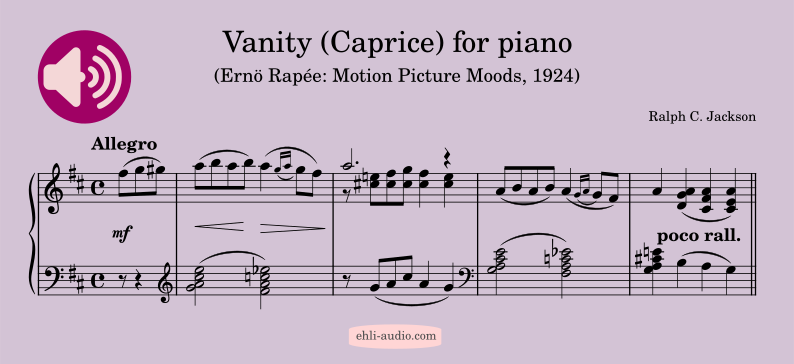
Lighthearted, unobtrusive salon music from the first decade of the 20th century by Ralph Clifford Jackson (1888–1921)[1], an American composer of the Tin Pan Alley era.
This piano composition can be found in Ernö Rapée’s famous work Motion Picture Moods (1924). Rapée classified it under the category “Parties” and recommended it as musical accompaniment for (presumably elegant) social gatherings in a refined setting—occasions characterized by cultivated conversation or polite small talk and a great deal of sophistication.
Music, then, perfectly suited for social scenes—such as those in the first-class smoking room and lounge on the Titanic—right up until the moment the band moved to the ship’s deck to play Lowell Mason’s "Nearer, My God, to Thee."
Hear the Sound
(retro style)
Download the Music
Play the Score
(optimized for easy reading on iPads and tablets)
The word "caprice"—which Ralph C. Jackson chose as a subtitle for his composition about vanity—was adopted into English from French. As a technical musical term, it traces back to the Italian capriccio. Originally, the term referred to freely composed fantasies—pieces not bound to a rigid structure, but instead characterized by original, surprising turns (in this sense, capriccio and scherzo can be considered equivalent).
During the 19th and early 20th centuries—the era of Jackson’s America—the term "caprice" was used as a subtitle for pleasing, cheerful, playful, and elegant character pieces, particularly within the realms of light music, salon music, and the accompaniment of silent films.
Footnote:
[1] A brief notice regarding his death can be found in the July 1921 issue of Variety magazine: "Ralph Clifford Jackson, age 33, a composer of popular music, was found dead in his offices at the Mason O. H. [Mason Opera House], Los Angeles, June 18."