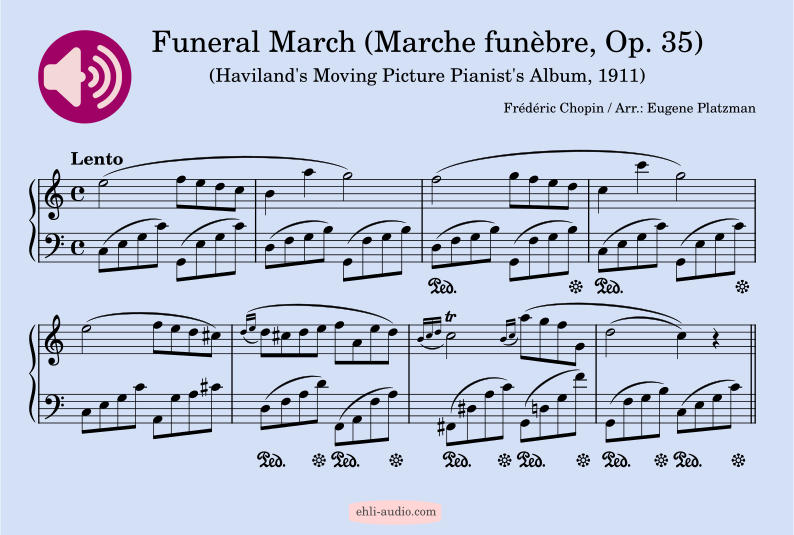
Chopin’s famous funeral march from his Piano Sonata No. 2—not to be confused with another marche funèbre that Chopin composed in his youth and which was published posthumously as Op. 72, No. 2—is the best-known work of its kind in the world. With its limping rhythm, hesitant gait, chords that strike like church bells, it has become the quintessential sonic embodiment of a funeral procession.
It is hardly surprising, then, that this funeral march appears in numerous musical anthologies intended to accompany burial or mourning scenes in silent films—including one of the earliest such collections, Haviland’s Moving Picture Pianist’s Album (1911). What is surprising, however, is that the arranger, Eugene Platzman, chose the march’s lesser-known middle section. This is particularly curious because this B-section, with its dreamy melody, momentarily departs from the somber, mournful character of the march itself.
Here is that middle section—the so-called trio—as it is notated in Haviland’s Album, intended to accompany sad moments:
**Hear the Sound (high fidelity)**
**Play The Score**
(optimized for easy reading on iPads and tablets)