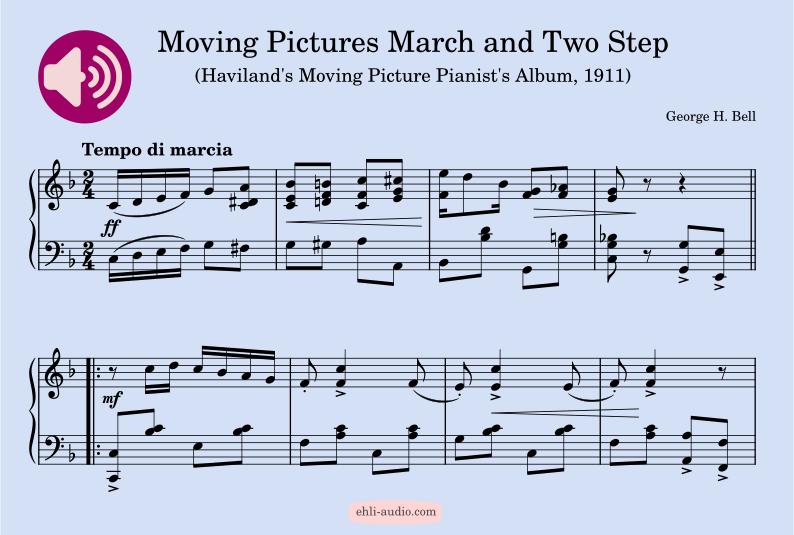
Experience a true rarity from the pioneering era of cinema! This historic "march and two-step" served as the rousing opening number in F. B. Haviland’s famous Moving Picture Pianist’s Album in 1911. Composed in a spirited 2/4 time, the piece perfectly captures the crackling excitement of the early movie theaters, known as "nickelodeons."
Musically, you can expect an exceptionally lively and cheerful work, brimming with energy: following a zesty opening, the march transitions into a melodic, softer trio section, ultimately culminating in a grand, proud grandioso finale played fortissimo.
Whether as an energetic overture for silent film screenings, a period-appropriate accompaniment for bustling everyday scenes, or simply as a cheerful, historic piano piece—this march brings the authentic sound of Tin Pan Alley back to the keyboard—and to your ears.
Now newly typeset and available exclusively here for listening and download:
**Hear the Sound (high fidelity)**
**Play the Score**
(optimized for easy reading on iPads and tablets)
Incidentally, a fascinating musical mystery lies hidden beyond the notes: the piece bears a copyright notice dated 1904. Yet, anyone searching the official 1904 copyright registry for this march will be in for a surprise—it is nowhere to be found! However, a composer named George H. Bell did indeed exist in New York at the turn of the century, and he was well-connected: on March 29, 1904, he was officially registered in the U.S. copyright records for the song "Kitty Lowery"—as the musical collaborator of the renowned Tin Pan Alley lyricist Jack Drislane. In the case of our "Moving Pictures" march, the publisher appears to have used the year 1904 as a clever ruse to deter both American and European copyright infringers ("Copyright 1904 by F. B. Haviland Pub. Co. [...] English Copyright Secured"), even though the piece only received legal protection in 1911 as part of the album.