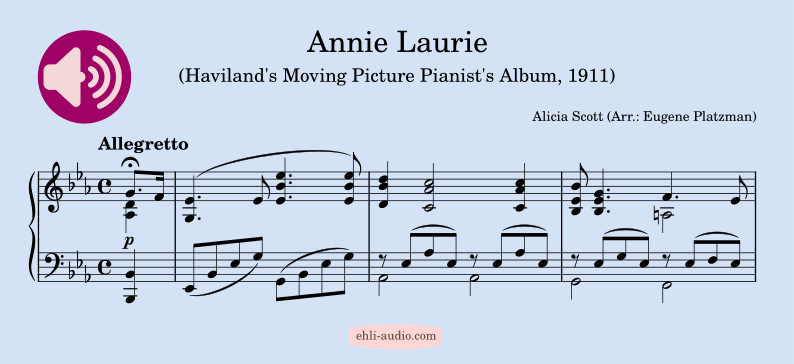
"Annie Laurie" is one of the most famous Scottish love songs. The lyrics tell of a deep, unconditional affection—one that ultimately meets a tragic end—and, above all, express longing and devotion. The original poem was written in the early 18th century by William Douglas (1672–1760) for his childhood sweetheart, Anna Laurie (1682–1764). Because her father opposed the union, the two were forbidden from marrying—making the song a testament to unfulfilled love.
In the lyrics, the narrator rhapsodizes about Annie’s beauty—her swan-white neck, dark eyes, and gentle voice—and pledges his eternal fidelity to her; for the sake of "bonnie Annie Laurie," he declares, he would even be willing to die ("I'd lay me doon and dee").
Because soldiers sang the song in the trenches during the Crimean War (1853–1856) and the American Civil War—thinking of their loved ones back home—the melody is still played today at memorial services and funerals as a gesture of farewell and an enduring bond.
Hear the Sound
(high fidelity)
Download the Music
Play the Score
(optimized for easy reading on iPads and tablets)
In the 19th century, Alicia Scott (Lady John Scott, 1810–1900) revised the original lyrics and composed the wonderful melody (possibly based on an old English tune). Early printed editions for voice and piano accompaniment can be found on IMSLP. The piano version provided here is taken from Haviland’s Moving Picture Pianist's Album, one of the very first American collections of photoplay music (1911).
Although Lady Scott, as a member of the nobility, surely owned a modern piano, we have opted for the sound of a harpsichord. It has a wonderful tone and, don’t you agree, suits a 200-year-old traditional piece quite well?